Tuesday, May 19, 2015

May 19, 2015 Springtime In Manhattan

Who could pass up a chance to be in Manhattan in the Spring?  When we received an invitation to a birthday party for a 90 year old friend, we didn’t waste a minute making plans and hotel reservations.  Ever have a magical week?  Mild temperatures, sunny every day and the opening of the new Whitney Museum-what could be better?

The official opening of the Whitney was May 1 but the following day was the neighborhood block party with free admission to the museum.  We had secured our free advance timed tickets online before we left home.  Were we ever grateful for those tickets when we got to the museum that day! The line for people without tickets stretched for blocks and blocks.


Museum staff kept everyone in order and stuck to the timing of the tickets.  When we finally got through the doors at 11AM, we took the express elevator to the eighth floor so we could walk down.  The elevator interiors were designed by Richard Artschwager.  


Even though the museum was full of people that day, the spacious galleries and the 30 ft. ceilings created plenty of space for viewing the art. The outdoor stairs were like an elegant fire escape with viewing platforms on each level and seating on several levels.  


Everyone hung over the railings capturing views of the Hudson River and The Highline.


As we’d once been New Yorkers and had been at the old Whitney many times,  this time was like visiting old friends.  Some favorites were Charles Burchfield’s Noontide In Late May, 1917 and George Tooker’s Subway 1950, a much smaller painting than I remembered. 


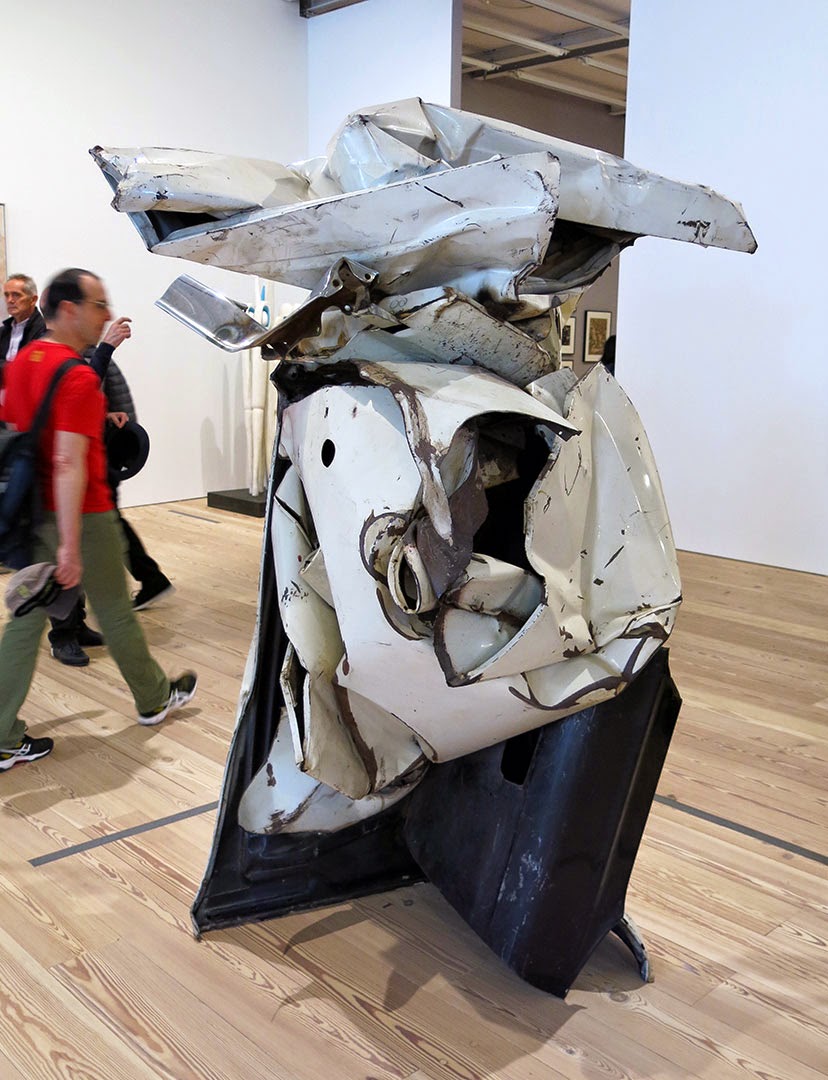
One of John Chamberlain’s crushed car sculptures, Velvet White 1962 captured my attention with its wonderfully contorted metal.  And I stood for a long time wondering at Jay DeFeo’s The Rose, 1958-66.  Weighing one ton, this work was built up out of layers of paint and carved.


 Loved the building, the art and the restaurant, appropriately named Untitled.  After lunch we took the Highline for a little way and then got off to see galleries in Chelsea.

Looking back at Whitney from The Highline

We’d read about an intriguing installation in Washington Square Park and visited that another day.  Only half installed with completion due by June 1, it was wondrous nevertheless.  Entitled Fata Morgana, the work is a creation of Teresita Fernandez.  Consisting of many mirror-polished irregularly shaped discs suspended in the leafy canopy in a metal framework,  the work  alters one’s perceptions and does create a mirage-like environment.


Tuesday, April 7, 2015

April 7, 2015 After the reception

A full moon with lights over the city of Boulder, CO provided a beautiful conclusion for the opening reception of my show, Then & Now, last Friday night.  Jazz guitar music by Ted Potter added a wonderful dimension to the evening.  Here are a few photos.

Setting up before the show


Tuesday, March 31, 2015

March 31, 2015 Then & Now

Announcing a show of my own work, Then & Now, featuring compositions from two series, Transformations and Playing In Traffic.  Work will be exhibited at National Center For Atmospheric Research in Boulder, CO, March 30-May 30, with an opening reception April 3 from 6-8PM.  Hope to see you there.

Sneak peek

March 31, 2015- No April Fool-That’s Tomorrow

I’d read a review in the Denver Post of a show called Constructed Histories at the David B. Smith Gallery downtown and didn’t want to miss it.  We made it on the last day and were glad we’d made the effort as the mixture of sculptural and 3-D work provided a lot to think about.

Jeremy Dean was represented by two very different works.  Everything That Rises,  a set of 16 used and battered metal folding chairs, joined together in a huge circle, makes us wonder how and where these chairs were used and what topics were discussed by people seated on them.


Convergence 2 is a pair of American flags, amazingly constructed from hundreds of colored parallel threads in several layers, each one attached to a single needle.


Side view-detail

Glenn Kaino, a 4th generation Japanese-American conceptual artist, combined unexpected and unlikely materials in several sculptural pieces.  Escala featured a number of scales held in precarious balance by small objects.


Hammers, yardsticks wine bottles and a solid wood rectangle came together to form another strangely balanced piece, A Plank For Every Pirate.


Stitching fragments of antique quilts together and applying acrylic paint and tar on top, Sanford Biggers created strata of references to, for example, quilts that were used to guide escaping slaves along the Underground Railroad.


Dinh Q. Lė’s work required distance and close-up viewing.  From across the room what emerged from a highly textured surface were powerful human figures.  From mid distance, it looked as if he had woven photographs together to produce this effect.  But up close, I was surprised to see that the hundreds of tiny pieces were not woven but glued in place over another photograph, requiring very meticulous work.


Detail

The work of McCallum Tarry also required viewing from several perspectives. Using photographs from the Civil Rights era, he overlaid each photo with a translucent piece of silk imprinted with a ghost of the photograph, creating an image that appeared holographic.


Side view

Christophe Draeger’s large black and white photographs record two instances of man-made destruction, the leveling of Nagasaki during WWII and the World Trade Center in 2001.  Presenting these images as large jigsaw puzzles made me think about how these places have put the pieces back together again and, on the other hand, whether we will ever fully understand the puzzle of how and why they happened.


Detail

Just down the street from David B. Smith gallery was Robischon, hosting a large and exciting photography show with many intriguing and haunting images.  The gallery’s large windows made it almost impossible to eliminate reflections from outside.  My apologies-any cars or unlikely buildings you may see were not in the artwork.  

The various artists participating in this show seems to share a common approach of making visible the land of dreams and the unconscious through constructed realities.  The contents of Maria Friberg’s large horizontal C-prints are like dreams which have ambiguous meanings and might be peaceful or threatening at the same time.  It is hard to know exactly what the young man in the water in Calmation is doing, merging with nature or drowning.  The beauty of the color and setting contribute to the confusion.


Over time, we have come to look forward to seeing new work by Halim Al-Karim.  In his current work, the evanescent quality of his images works well to evoke a nostalgic feeling of former times as well as the nature of personal memories.  Amazing to see was a large collodion print, a technically difficult feat to pull off.


A dreamlike quality continued in Christine Buchsbaum’s work.  Her staged images had an eerie feeling that leave the viewer uncertain about the story line.  Her photographs also combined both peaceful and uneasy aspects.


Taking inspiration from the Chinese legend of The Monkey King, Chi Peng’s wild imagination gave us nude male winged bodies flying over a wide landscape with a carousel in the distance in June 19, 1981.    The Monkey King somehow overlaid the notion of the legendary character with that of the well-known film personality.


David Zimmer showed three works from Finch studies, pieces using sound, motion and a constructed environment.  Birdsong could be heard through the galleries.  Each bird flitted and hopped engagingly in its own niche.


Placed in a kind of paradise, Ruud van Empel’s image, collaged from hundreds of his own digital photographs, creates it’s own story  Dawn reminded me in some ways of an Henri Rousseau painting.


Kahn + Selesnick are also repeat artists at Robischon and always engage with their very mysterious compositions.  Like stills from a movie, their current work depicts scenes from a fiction about a traveling cabaret group composed of a strange variety of creatures.


Thursday, February 26, 2015

February 26, 2015 Before it snowed, and snowed

Looking out the window this morning, it’s hard to believe that there was ever a warm weekend in February.  But there was and it included Valentine’s Day.  We took advantage of the mild temperatures and went downtown in Denver to check out a couple of shows.  Robischon Gallery was hosting three solo shows in its main galleries and a fourth in the “back room.”

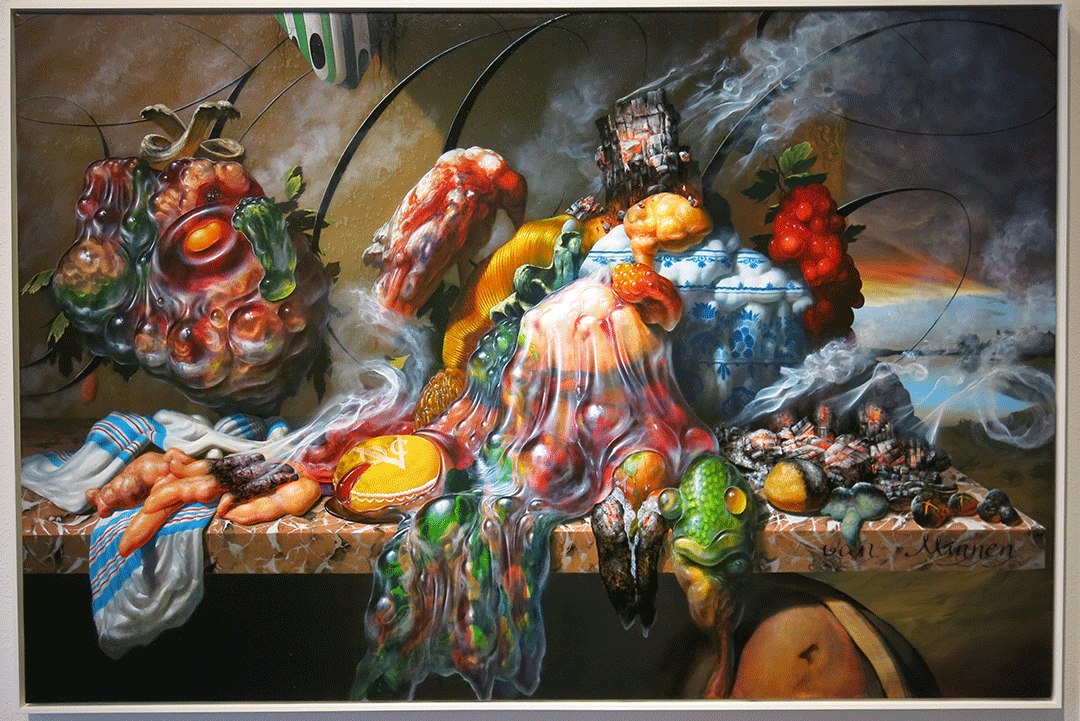
Front and center was Christian Rex van Minnem’s Golden Memes. Combining the painting style and preferred subject matter of 17th century Dutch masters with recognizably contemporary items, his work creates a tension between his beautiful virtuoso painting and the repellant nature of some of the contents.  His work compares our contemporary preoccupation with material excess and a similar absorption in 17th century Holland with exotic goods traded from the colonies.

Google Gnostic attracts from a distance with its bright hues and shiny surfaces until, on closer inspection, you begin to see a dismembered torso, bleeding octopus spilling intestines and a very distorted face.


In VOC Jellyfish Fry, the letters representing the first Dutch brand are found on the yellow cake.  Other objects. which in Dutch paintings were rendered as whole, fresh and enticing edibles, here seem to be dripping and oozing on their way to disintegration.  Like them or not, van Minnem’s work successfully carries out its intent.


Around the corner in the next gallery, was a large selection of paintings, Descriptors, by Jerry Kunkel, a Denver artist who for many years has produced work with a surrealist bent and an often wry sense of humor.  In his current show, he makes reference to well known paintings from art history while providing his own twist with words layered over the images or by adding contemporary objects.

Like, an image that looks a lot like a paint-by-numbers scene, turns the table on viewers by declaring, “This painting doesn't like you.”  The weathered wood border is actually part of the painting.


PB&J and Boucher places a gooey peanut butter and jelly sandwich opposite
a pair of plump delectable lovers.


Additional works filled a wall with sixteen 12” square paintings with titles such as Fiction Is Never Not True; Silence Isn’t Golden, It’s Cryptic; and There Is No Good Best Time, all amusing and very thought-provoking.

Jean Lowe’s A More Beautiful You was in the form of a bookstore or library with papier-mâché tomes presented on white shelves.  Providing an uncomfortable and sarcastic view of contemporary life with titles referring to preoccupation with beauty, self-help and other topics,  these lightweight books confront with their garish colors and cartoon-like shapes.


Wes Hempel’s paintings in the back room fit well with the rest of the show.  Like art history selfies, they combined accomplished portraiture with text.

When You Look At Me I See What You Feel and I Feel What You See

Your Touch That Was Not A Mistake  Not Mistaken

There’s still time to see these intriguing shows.  They are on until March 7.

Redline Gallery and Artist Studios featured a show called Just Playing (with the word Playing inverted).  This show is on until March 1.

Fuzzy Terrain, 2014, by Jodi Stuart, was a lenticular digital print in which colors and forms shifted as you walked slowly past it.


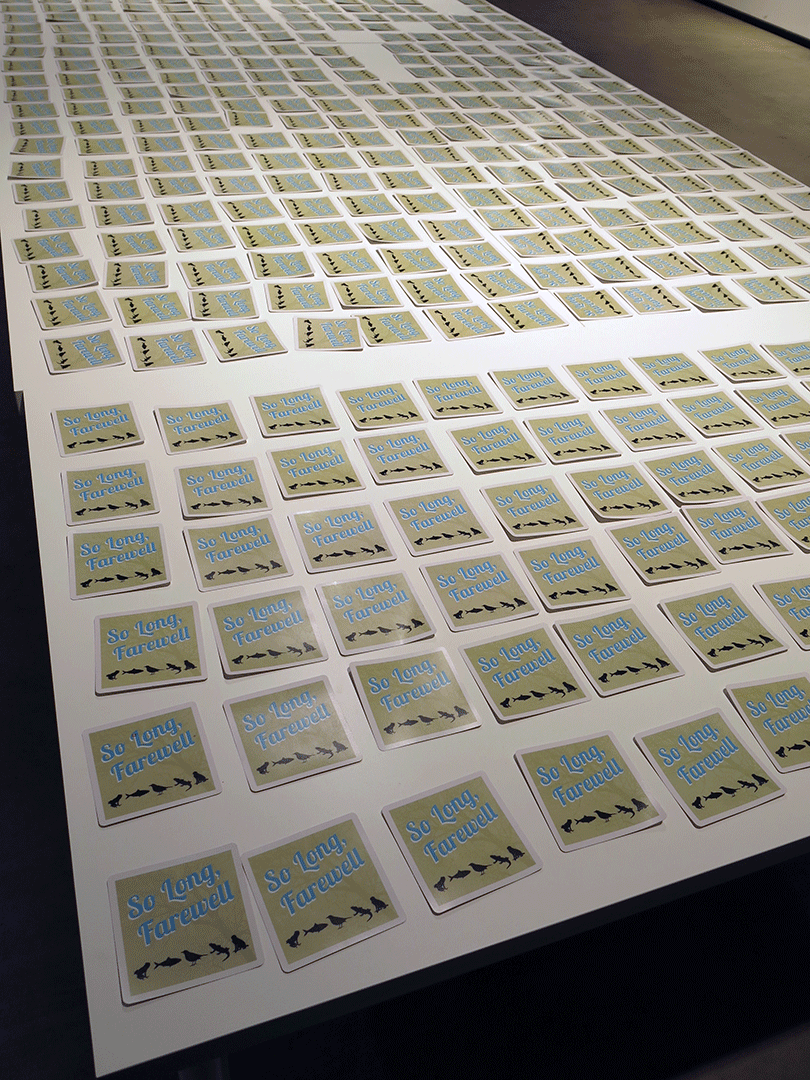
Displayed on a long table, Daisy Patten’s artist-made playing cards invited interaction.  Like memory-matching games,  the pieces in So Long, Farewell:  Extinction in the Anthropocene Era, 2014, depicted animals under threat of extinction.  Viewers were asked to match pairs of cards showing the same animal and place them in a box.


Libby Barbee used Ralph Waldo Emerson’s essay, Nature, as inspiration for her work, With Emerson, 2014.  Each of the four pieces was created according to rules stimulated by each chapter.


Homare Ikeda’s, Boundaries: When To Play and Where to Play, presented collages of such varied contents as cardboard, a clock, graphite stick, wire, painting on board, tapes and aluminum foil.


Andy Rising’s, Hypernatural Surface Flow and Core Extraction, Devil’s Head, CO, 2015, was a sculptural presence about human-size.  When light played over the incised piece, the full beauty of the surface was visible.  


Detail

The variety of work and the many layered meanings gave us lots to talk about during dinner at Osteria Marco in Larimer Square.